




In many industries such as oil & gas, chemical processing, food & beverage, and water treatment, measuring the liquid level in tanks is a critical parameter for ensuring safe and stable operations.
Accurate level measurement helps operators monitor inventory, prevent overflow, and maintain efficient production processes.
However, in real-world industrial environments, many level measurement systems perform poorly or experience frequent failures due to incorrect sensor selection or improper installation.
Below are five common mistakes when selecting liquid level sensors in industrial applications and how to avoid them.
1. Choosing the Wrong Level Measurement Technology
Today, there are many level measurement technologies available, and each is designed for specific applications.
Common technologies include:
| Technology | Typical Applications |
|---|---|
| Radar level sensor | Chemicals, oils, solvents |
| Ultrasonic sensor | Clean water, wastewater |
| Differential pressure | Pressurized tanks |
| Capacitive sensor | Liquids with high dielectric constant |
| Hydrostatic level sensor | Deep wells, wastewater |
Selecting the wrong technology can lead to several issues such as:
-
Unstable measurement signals
-
High measurement errors
-
Loss of level signal
Therefore, understanding the process conditions and application requirements is the first and most important step when selecting a level sensor.
2. Ignoring the Dielectric Constant of the Liquid
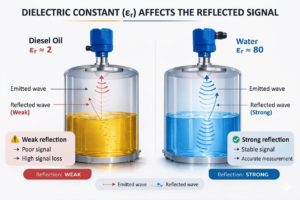
For technologies such as radar or capacitive level sensors, the dielectric constant (εr) of the liquid plays a crucial role in signal reflection.
The dielectric constant directly affects how well the signal is reflected back to the sensor.
Examples:
-
Diesel fuel: εr ≈ 2
-
Water: εr ≈ 80
Liquids with a low dielectric constant produce weaker signal reflections, which may cause:
-
Poor signal quality
-
Reduced measurement accuracy
-
Signal loss
Before selecting a level measurement device, it is important to identify the physical properties of the liquid being measured.
3. Installing the Sensor in the Wrong Location
Even when the correct sensor type is selected, improper installation can still cause measurement problems.
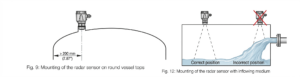
Common installation mistakes include placing the sensor:
-
Too close to the tank wall
-
Near the inlet pipe
-
Close to agitators or internal structures
These obstacles may create false reflections or signal interference, resulting in fluctuating or incorrect level readings.
To ensure accurate measurements:
-
Install sensors away from obstacles
-
Follow manufacturer installation guidelines
-
Consider the internal structure of the tank
4. Ignoring Process Conditions Inside the Tank
Industrial tanks often operate under challenging process conditions that can affect sensor performance.
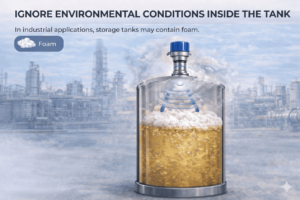
Common factors include:
-
Foam on the liquid surface
-
Chemical vapors
-
High temperature
-
High pressure
-
Condensation
Certain technologies are more sensitive to these conditions, particularly:
-
Ultrasonic level sensors
-
Capacitive sensors
-
Some radar configurations
Evaluating actual operating conditions before selecting the sensor is essential to ensure long-term measurement reliability.
5. Overlooking Safety Requirements in Hazardous Areas
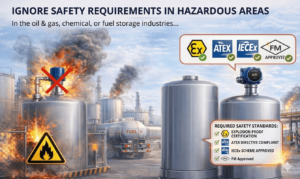
Industries such as oil & gas, chemical processing, and fuel storage often operate in hazardous environments where explosive gases or vapors may be present.
In these areas, instrumentation must comply with international safety certifications such as:
-
ATEX
-
IECEx
-
FM approval
Using equipment without the required certifications can lead to:
-
Safety risks
-
Potential explosions
-
Regulatory violations
Therefore, selecting certified level measurement devices is critical when operating in hazardous locations.
Conclusion
Selecting the right liquid level sensor is essential for ensuring reliable and safe industrial operations.
Avoiding common mistakes such as:
-
Choosing the wrong technology
-
Ignoring liquid properties
-
Improper installation
-
Overlooking process conditions
-
Ignoring safety certifications
can significantly improve measurement accuracy, system reliability, and plant safety.
By carefully evaluating application requirements and selecting the appropriate level measurement technology, companies can reduce maintenance costs, minimize downtime, and improve overall operational efficiency.