




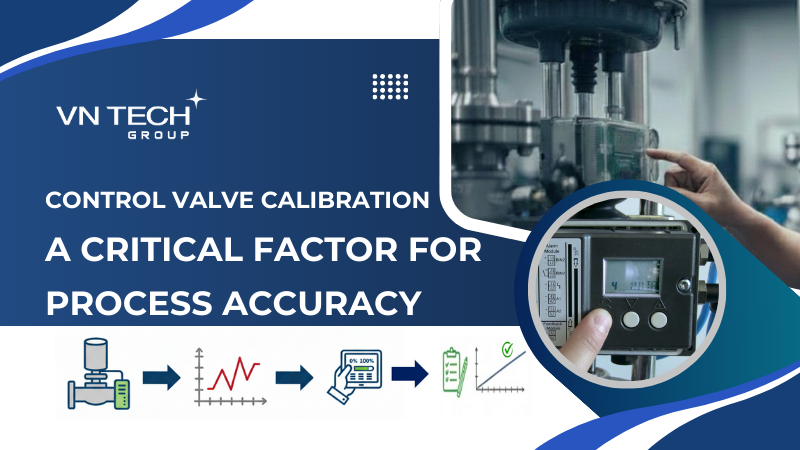
Control Valve Calibration – Ensuring Accuracy and Efficiency in Industrial Automation
In industrial automation systems, control valves are one of the most critical components for regulating flow, pressure, and temperature.
Even the most advanced control valves can gradually lose accuracy over time due to mechanical wear, environmental conditions, and continuous operation.
This is why control valve calibration is essential to ensure stable process control, optimal performance, and long-term system reliability.

1. Why Control Valve Calibration Is Necessary
1.1 Mechanical wear and operating conditions
During continuous operation, control valves are exposed to:
-
Mechanical friction between valve stem, plug, and seat
-
Vibration from pipelines and surrounding equipment
-
Thermal expansion caused by temperature fluctuations
-
Contamination or deposits in the process media
These factors gradually shift the valve’s mechanical reference points, causing deviations between the control signal and the actual valve position.

1.2 Signal deviation and loss of linearity
Without proper calibration, a control valve may no longer respond linearly:
-
A 50% control signal may result in only 48% actual valve opening
-
At the end positions, the valve may fail to fully close at 0% or fully open at 100%
Such deviations reduce the effectiveness of DCS or PLC control loops and may lead to unstable process behavior.

2. The Purpose of Control Valve Calibration
Control valve calibration is not just a maintenance task—it is a strategic action that directly impacts productivity, safety, and operating costs.
2.1 Restoring accurate linear control
Proper calibration ensures that:
-
A control signal of x% corresponds exactly to x% valve travel
-
The feedback signal accurately reflects the real valve position
-
Control loops operate smoothly and predictably
This level of accuracy is essential for precise process regulation.

2.2 Reducing energy consumption and operating costs
Incorrect valve positioning can cause:
-
Excessive flow, steam, or fuel usage
-
Increased actuator workload
-
Faster wear of mechanical components
Calibrating the valve at 0% and 100% positions prevents overtravel and unnecessary actuator stress, helping reduce energy and maintenance costs.
2.3 Improving product quality and process consistency
In industries such as:
-
Pharmaceuticals
-
Food & Beverage
-
Chemical processing
-
Power generation
Even minor control deviations can affect product quality.
Control valve calibration ensures consistent process conditions, resulting in stable and repeatable product quality.
3. When Should Control Valves Be Calibrated?
Control valve calibration is recommended:
-
After long-term continuous operation
-
When replacing actuators or positioners
-
After mechanical maintenance or system upgrades
-
When control instability or unexplained deviations occur
Routine calibration helps prevent unexpected failures and production downtime.

4. Professional Control Valve Calibration by VNTECH GROUP
To ensure maximum accuracy and reliability, VNTECH GROUP provides professional control valve calibration services, including:
-
0%–100% calibration for linear control valves
-
Verification of actuator and positioner performance
-
On-site technical assessment and optimization
-
Customized solutions for each industrial application
Our experienced engineers understand real plant conditions and deliver solutions that enhance system performance and equipment lifetime.
Conclusion
Control valve calibration is a fundamental requirement for accurate, stable, and efficient industrial automation systems.
By restoring correct valve positioning and linearity, calibration helps reduce operating costs, improve product quality, and ensure long-term process reliability.
Investing in proper control valve calibration is an investment in performance, safety, and sustainability.